

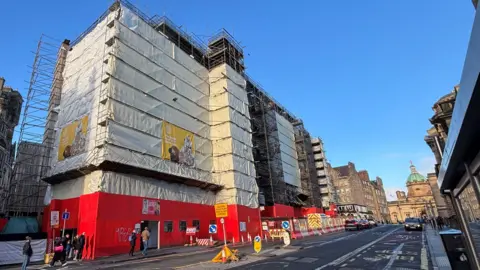
Along the most popular thoroughfares in the heart of Scotland's ancient city sits a giant structure of scaffolding.
For half a decade, Radisson's G&V Hotel on the corner of the famous Royal Mile and the adjacent bridge has been a shrouded blight.
Travellers cannot book rooms, pedestrians are directed through confined passages, and commercial tenants have left the building.
Repair work commenced in 2020 and was originally estimated to last a short period, but now exasperated residents have been told the framework could persist until 2027.
Prolonged Deadlines
Sir Robert McAlpine (SRM), the main contractor, says it will be "near the finish" of 2026 before the earliest portions of the structure can be removed.
The city's political leader a city representative has called it a "blight" on the area, while heritage campaigners say the work is "very troublesome".
What is happening with this notoriously protracted project?
Background Issues
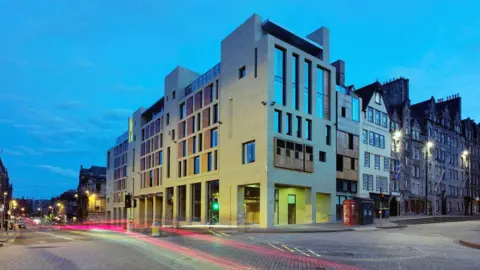
The sizeable hotel was constructed on the site of the previous local government offices in 2009.
Figures from when it first opened under the a designer banner, put the build cost at about thirty million pounds.
Construction activity got underway not long after the start of the Covid pandemic with the hotel itself closed to guests since 2022.
A lane of traffic and a sizable stretch of footpath leading up to the junction of the historic street have been closed off by the development.
People on foot going to and from the Lawnmarket and Victoria Terrace have been compelled one after another into a narrow, covered walkway.
Seafood restaurant Ondine left the building and moved to St Andrews in Fife in 2024.
In a comment, its operators said the ongoing project had obliged them to modify the restaurant's appearance, adding that "guests were entitled to a superior experience".
It is also the location of dining franchise a chain – which has hung large notices on the scaffold to notify customers it is open for business.
Delayed Plans
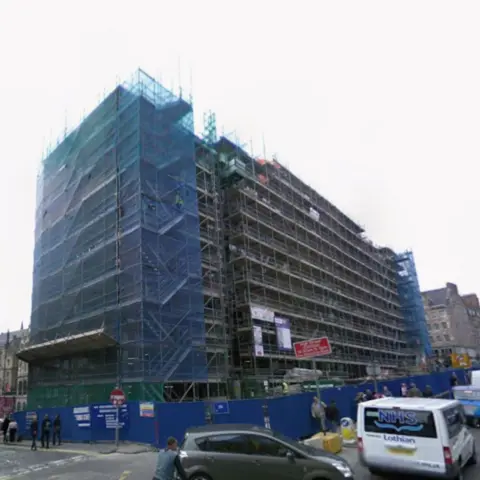
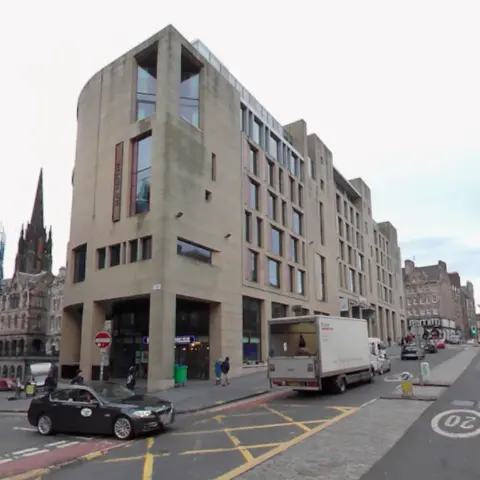
An report to the council's transport and environment committee in January this year stated that the process of "revealing" the frontage would commence in February, with a total takedown by the year's end.
But the firm has said that is incorrect, pointing to "highly complicated" construction issues for the delay.
"We expect starting to take down sections of the framework near the finish of 2026, with additional work ongoing after that," the company commented.
"We are working closely with all parties to ensure we create an improved site for the local area."
Community and Heritage Concerns
Rowan Brown, lead of heritage body the an advocacy group, said the work had contributed to the city's reputation of being "slow" for construction projects.
She said those associated with the project had a "obligation to the public" to minimise disruption and should integrate the work into the city's design.
She said: "It causes the walking experience in that area of the city really difficult.
"It is perplexing why there is not an effort to bring it into the street view or create something more artistic and innovative."

Ongoing Efforts
A company representative said work on "solutions to beautify the site" was ongoing.
They stated: "We acknowledge the irritations felt by nearby inhabitants and shops.
"This constitutes a long and drawn-out process, highlighting the intricacy and magnitude of the restoration required, however we are dedicated to concluding this necessary work as soon as is possible."
The official said the council would "maintain pressure" on those involved to complete the project.
She said: "This scaffolding has been a blight for years, and I echo the frustration of locals and area enterprises over these continued delays.
"However, I also recognize that the firm has a obligation to make the building safe and that this restoration has been hugely complex."


